
The Empowerment Trap
On free will, false empowerment, and the question that kept me stuck for years: did I choose this?

I didn’t lose my individuality by force. I gave it away willingly, convinced I was becoming more myself.
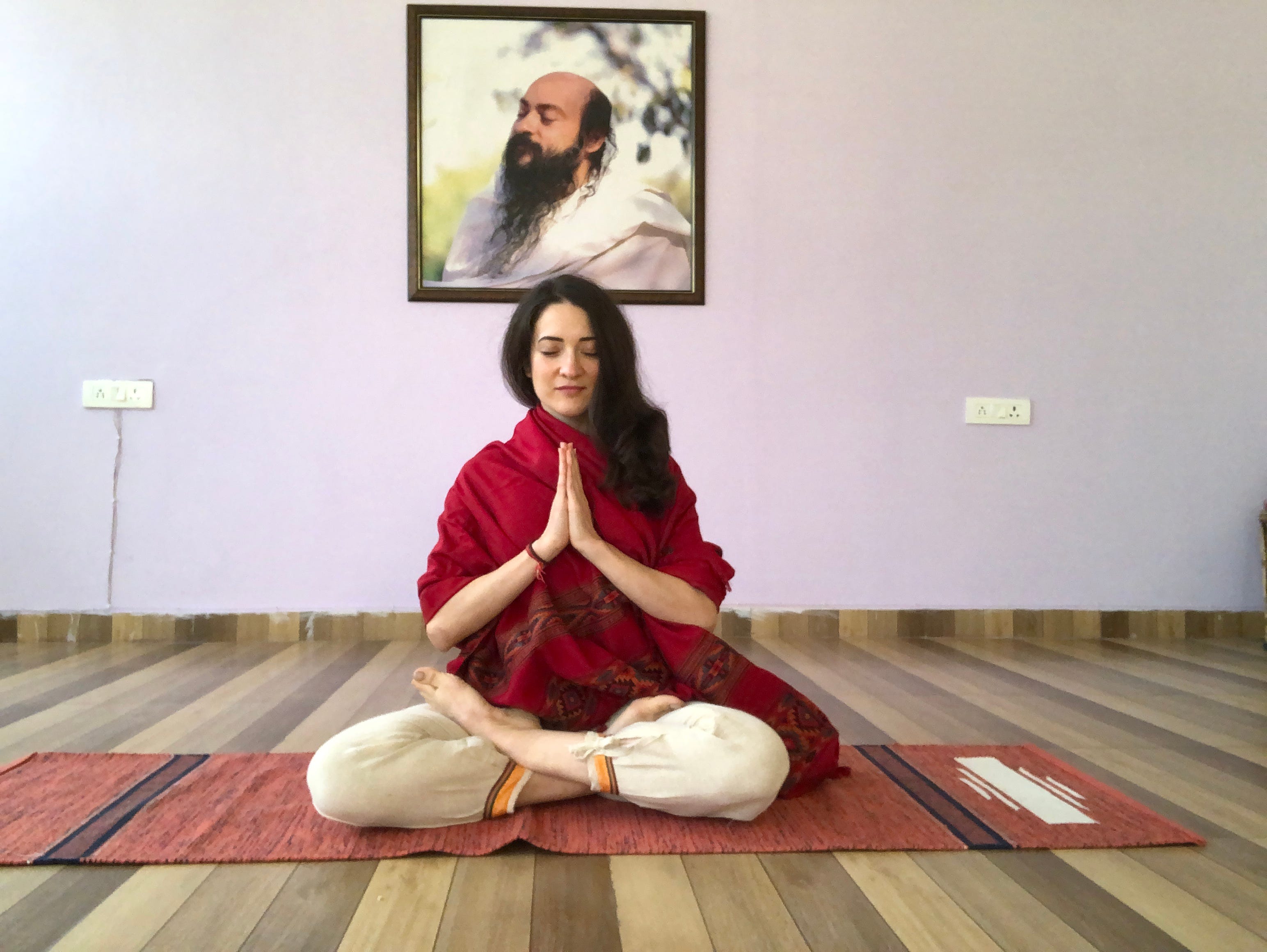
I walk into the yoga hall and there’s a word on the whiteboard in blocked, capital letters.
SATTVA.
I don’t know what it means. But something in my body responds to it before my mind could catch up. I don’t know how to describe it, but this strange combination of letters feels like mine. I just know— the way you intuitively know something in a dream without context—that this word has something to do with me.
It’s been raining for days. Winds so strong it knocked down part of the patio wall upstairs and flooded our kitchen and common area. The Himalayas are stormy and moody in the winter and so am I. It’s been 17 days in the ashram and I still haven’t been able to hold onto peace. Grief and rage are unwanted visitors that I carry inside. There’s no way I’m going to let my ego ruin this for me, I tell myself every time those pesky intruders try to sabotage my growth.
Seventeen days doesn’t sound like much, but when you’re meditating eight hours a day, something funny happens with time. It collapses and moves at lightning speed as your circadian rhythm slows way down. Seventeen days feels like seventeen years. By now I am already in love with Osho, convinced he has guided me all this way and guiding me still. He is the first person to breathe life into my consciousness, to make sense of my suffering, to put context around the maelstrom of emotions inside me. To give words to the strange and exhausting experience of my “me”-ness.
SATTVA.
We go straight into meditation, as usual. There’s a gentle vibration coming out of the speakers in the form of sound. I find my spot on the mat and close my eyes, and all I can think about is that word. Turning the consonants over in my mind, visualizing it through my third eye, tracing the curves and edges of each letter, swirling the syllables around and around in my head, looking for a place to land them in my body. Satt-va. Sa-ttva. Inhale sat, exhale va. I remember from Kundalini yoga that sat means Truth. Sat Nam = true identity. Truth be thy name.
That’s what I wanted the most, out of anything in this world of broken promises and unrequited dreams. Truth.
The meditation is over. My guruji approaches me with a pen and gestures for my notebook where I scribble spontaneous reflections. I’m embarrassed for him to see what I’ve written, but luckily he turns it to the last blank page. He writes in block letters in near-perfect handwriting:
MA: MOTHERHOOD
YOG: UNION
SATTVA: PURE AND DIVINE ENERGY, QUALITY, OR ESSENCE.
He tells me that Osho channeled this name through his consciousness and it would be my sannyasin name. More than just a name, but a higher self, one who is committed to truth and beauty and bliss, one who doesn’t carry the weight of being Margarit—confused, insecure, ordinary, unsure of who she is or what she wants. Sattva doesn’t have those problems. Sattva is a rebirth, a fresh start, a transformation. God, I needed that.
I don’t concern myself with what this means, what this transformation will require of me, what I would need to sacrifice to receive it, what my life in LA will look like when the last remaining structure of my identity keeps me tethered to a life that Spirit is asking me to outgrow.
“Dear Sattva,” I write in my journal that evening. “You came in by a storm.”
My actual birthday is in March, spring season, and this name serendipitously arrives the same way I did — uninvited by anyone but the universe. And I’m not asking whether the universe actually works this way or whether a heartbroken woman in the Himalayas is simply very good at finding patterns in chaos, because asking those questions would mean the whole thing unravels, and I am not ready for it to unravel. I am ready to believe. I have never been more ready to believe in anything.
And there is a small voice, barely audible beneath all the revelation, saying this is not you, you’re just trying this on, you don’t have to do this. It fills me with quiet dread but I tell myself it’s just growing pains, this voice is just my ego in resistance, my fear of the unknown, my attachment to a life that forces me to abandon my True Nature.
I focus on the magnitude of what I’ve been chosen for. I tell myself I should be grateful.
I am in denial. I am gaslighting myself.
I just don’t have the language for what is happening to me yet.
The language arrives six years later, in the last place I would expect to find it.
It is Fall of 2024 and my first semester of grad school where I’m pursuing my MSW. I am sitting in a course called Diversity, Equity, and Inclusion in Social Work — a class about power, privilege, oppression, and how those dynamics live inside every relationship where there’s an inherent power imbalance. My cohort is about 90% Latinx and I am one of the few white women in the program, which is itself an education in sitting with my own positionality, my own privilege, the parts of the power equation that benefit me and the parts I’m still reckoning with to this day.
The world outside the classroom has grown impossibly louder since the pandemic. The 2024 election just happened. The whole country is drowning in discourse about strongmen and authoritarianism and the seductive appeal of leaders who tell people what they want to hear. Democracy is dying. HBO just dropped Breath of Fire, a documentary about Guru Jagat — a Kundalini yoga teacher in Venice (practically my backyard) — who went by a spiritual name her guru gave her, who built a brand on personal empowerment rhetoric, whose community protected the narrative until the whole thing fell apart and she died. A woman who, in a lot of ways I don’t want to think about too carefully, followed a trajectory that rhymes with mine.
In class, we are studying a dense academic paper by a social work researcher named Jerry Tew: Understanding Power and Powerlessness: Towards a Framework for Emancipatory Practice in Social Work. Truly one of those titles that loses you before you even start. But Tew is writing about something that grabs me and shakes me out of my looming apathy towards my past, present, and future.
He’s arguing that the word “empowerment” gets used in two completely different ways, and most people never notice the difference. In one version, empowerment means people building power together through collective action, mutual support, solidarity, the kind of agency that actually redistributes power. In the other version, it means you, alone, working on yourself, figuring your shit out, taking radical personal responsibility for your healing and your growth and your consciousness — while the people who hold structural power stay exactly where they are.
I know that second version all too well. It is painfully familiar to me, not from a textbook but from my body. From the four years inside the Osho cult and even a decade before that as a self-proclaimed “self-help junkie,” I’m intimately familiar with relating to my life as a never-ending self-improvement project.
I don’t connect Tew to the ashram in that classroom. Not explicitly, at least. That realization takes another year to materialize, when I start building this series and the ideas I’ve been carrying around like loose particles finally take form. By now, I’ve already distanced myself from the self-help industry and rejected their version of self-empowerment that tries to convince people they can heal and manifest and vibrate their way out of systemic failure. I already know, intellectually, that individual empowerment without structural accountability is incomplete at best and predatory at worst. But Tew gives me the mechanism. He doesn’t just say the system is broken. He names the exact architecture I’ve been trapped inside.
This is the piece I promised paid subscribers when I published the yellow flags post. It’s a critical reflection on the question that kept me stuck for years after I left: did I choose this? And if I did, what does “choice” even mean when you’re making decisions inside a system that was designed to define the terms of your freedom before you even walked through the door?
This one’s for the academics, the thinkers, the cerebrally curious. But honestly it’s also for the person who’s been stuck between “I chose to be there” and “something was very wrong” and can’t figure out how to hold both of those truths without one of them canceling the other out.